
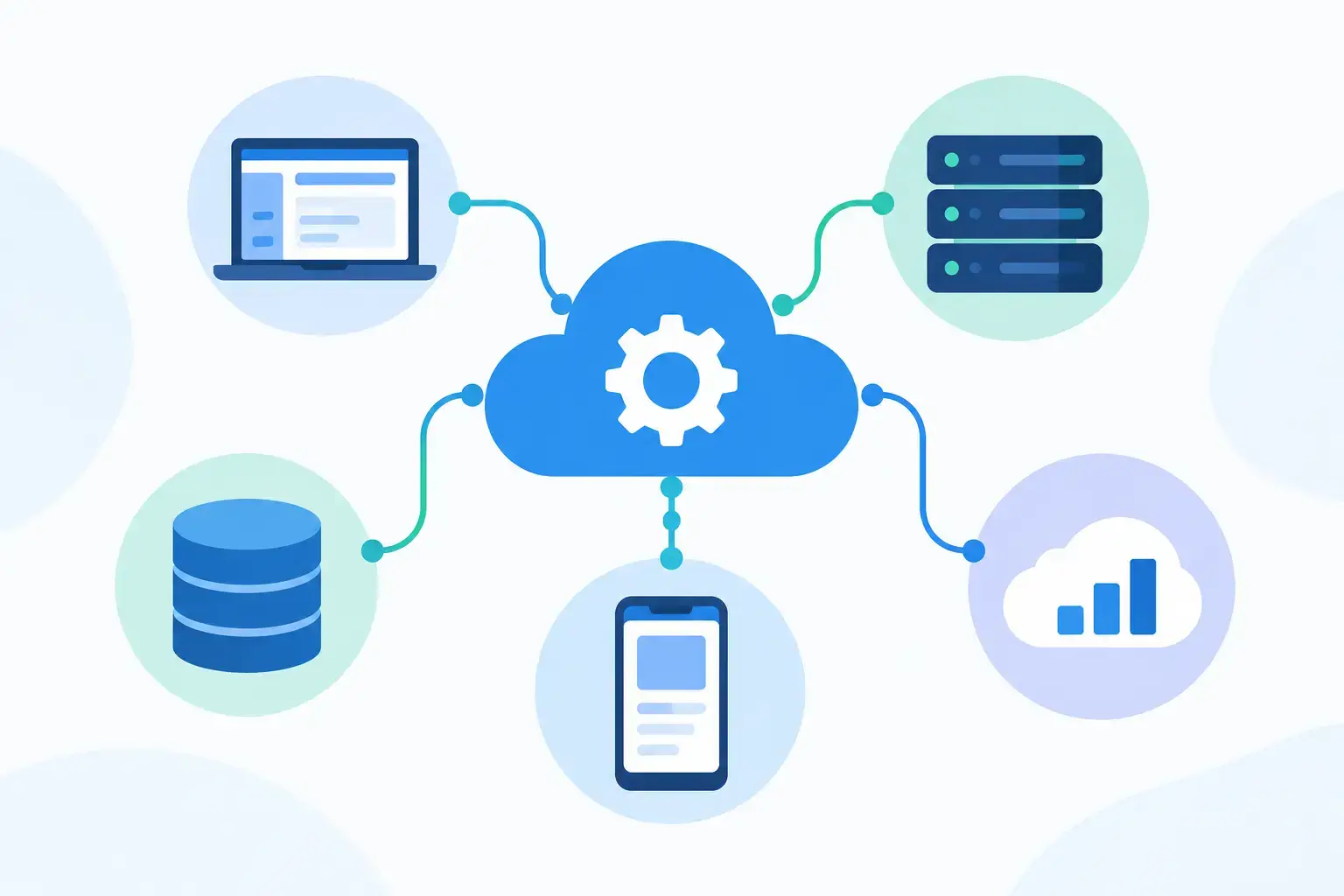
When a sales team updates customer details in the CRM, warehouse staff should not need to re-enter them into the ERP. When an ecommerce order is placed, stock, pricing, fulfilment and customer communications should move without someone checking spreadsheets. That is the practical value of an API strategy: deciding how your systems exchange data reliably, securely and in a way that supports the business as it grows.
Treating APIs as a technical detail to address only after a project starts can produce fragile point-to-point connections, held together by manual fixes and knowledge that sits with one person. A sound strategy starts earlier. It asks which systems should own which data, what needs to happen automatically, where people should remain in control and how each connection will be maintained.
What an API strategy should achieve
An API strategy is not a plan to connect every platform you use. More integrations do not automatically mean better operations. The goal is to create useful, dependable data movement between the systems that run your business.
That might mean synchronising product catalogues from suppliers into an ecommerce store, creating ERP sales orders when customers check out online, or routing service requests from a customer portal to the right internal team. It could also mean making a controlled set of business data available to a mobile app, reporting tool or AI workflow.
Define the commercial outcomes you expect to measure. Less double handling can reduce processing time and transcription errors. Timely, accurate data can help teams respond to customers and fulfil orders. A well-planned API layer may also reduce reliance on manual SaaS workarounds, although it introduces its own maintenance costs.
Start with processes, not platforms
A common mistake is choosing an integration tool or writing code before understanding the process being improved. Software vendors will often show how easily their product connects to another product. That does not answer whether the resulting workflow fits how your team operates.
Start with the moments where work slows down, data is duplicated or errors regularly occur. Follow a transaction from beginning to end. For example, an online order may pass through ecommerce, payments, inventory, ERP, freight and customer support. At each stage, identify what information is needed, who changes it and what happens if the data is missing or wrong.
This process usually exposes a more useful question than, “Can these systems integrate?” The better question is, “What must happen automatically, and what needs a person to review?”
A high-value integration might automatically create an order in the ERP but hold exceptions for staff review when a delivery address is incomplete, a customer exceeds their credit limit or a supplier has no stock. Full automation is not always the right target. Controlled automation is.
Define the source of truth
Every critical data type needs a clear owner. Customer contact details may belong in the CRM. Product pricing may belong in the ERP or a product information system. Order status may be managed by the fulfilment platform. Without this decision, systems overwrite each other and staff lose confidence in the data.
The source of truth does not have to be one platform for the entire business. It should be one platform for each type of information. The API strategy then defines which changes flow out, where they go and whether they are immediate, scheduled or triggered by an event.
For example, stock availability may need near real-time updates to reduce the risk of overselling, while a nightly synchronisation may be sufficient for archived product attributes. Updates alone do not prevent overselling: stock reservation and concurrent order handling also need explicit rules. The right approach depends on operational risk, transaction volume, platform limits and cost.
Design the API strategy for change
Business systems change. You may replace an ecommerce platform, add a new warehouse, introduce a customer portal or connect a supplier feed with different data fields. An integration built only for the current setup can turn every change into a costly rebuild.
A scalable design separates business logic from individual vendor connections where practical. Instead of embedding product mapping rules in multiple locations, centralise them in a service or integration layer. Instead of allowing every system to directly connect to every other system, use defined pathways for key data.
This does not mean building a large enterprise architecture for a business that needs two critical connections. Overengineering is as costly as a brittle shortcut. The right level of structure depends on the complexity of your operations and the likelihood of change.
For a growing business, a sensible first step might be a small integration service that validates orders and synchronises stock between two core systems. For an established organisation managing multiple brands, channels and suppliers, a more formal API layer may be necessary to keep data rules consistent across the business.
Build for failures, not just happy paths
An integration is only useful if it handles the situations that occur outside a clean product demonstration. APIs can be unavailable. A supplier may send incomplete data. A duplicate message can arrive. A staff member can update a record while a synchronisation is running.
Your strategy should specify how these events are managed. Failed transactions need to be logged clearly, retried safely where appropriate and visible to the people responsible for resolving them. Alerts should be meaningful. An operations manager needs to know that orders are not reaching the ERP, not receive a vague technical message with no action attached.
Idempotency also matters for transactions such as orders and payments. In practical terms, a retry should not accidentally create a second order or charge a customer twice. These controls are not technical decoration. They protect revenue, customer trust and staff time.
Security and access need business rules
APIs can expose valuable business data, so security cannot be an afterthought. Each connection should have the minimum access required to perform its job. A catalogue synchronisation does not need permission to alter customer records. A reporting service usually does not need the ability to create orders.
Use secure authentication methods, protect credentials, plan key rotation and revocation according to the provider and your risk assessment, and keep an audit trail of significant actions. Where customer or commercially sensitive data is involved, also consider Australian privacy obligations and your own contractual requirements.
Access decisions should be documented in language the business can understand. Who can access customer data? Which systems can change pricing? What happens when a staff member leaves? These are operational questions with technical controls behind them.
Measure value after launch
An API strategy is incomplete if success is defined only as “the integration went live”. Track the operational measures the connection was meant to improve. This could include manual processing time, order error rates, time to update stock, support ticket volume or the time needed to onboard a new supplier.
Set a baseline before implementation where possible. If staff currently spend ten hours each week correcting product data, the new process should show whether that time has reduced. If stock discrepancies are causing cancelled orders, monitor whether the integration improves availability accuracy.
These measures also help prioritise the next piece of work. A connection that saves minutes but requires significant ongoing support may not be the next best investment. A modest integration that removes a daily bottleneck across sales, operations and finance often is.
Treat APIs as business infrastructure
The strongest API strategy treats integrations as part of how the business operates, not as a collection of one-off technical projects. Give critical connections an owner, maintain documentation and review them when systems or processes change. Budget for maintenance rather than assuming an integration is finished forever.
This approach gives businesses more control over their technology choices. You can add tools where they create value, replace platforms when they no longer fit and retain the workflow logic that makes your operation different. That is particularly valuable when generic software forces teams into compromises or recurring subscription costs keep rising.
Codex’s systems integration services help businesses map these workflows and design connections around the way teams work. The aim is not to add technology for its own sake. It is to make information move where it needs to, with fewer manual steps and clearer accountability.
The best place to begin is often one process your team already knows is broken. Fix that connection properly, measure the improvement, then use the result to shape the next decision.