
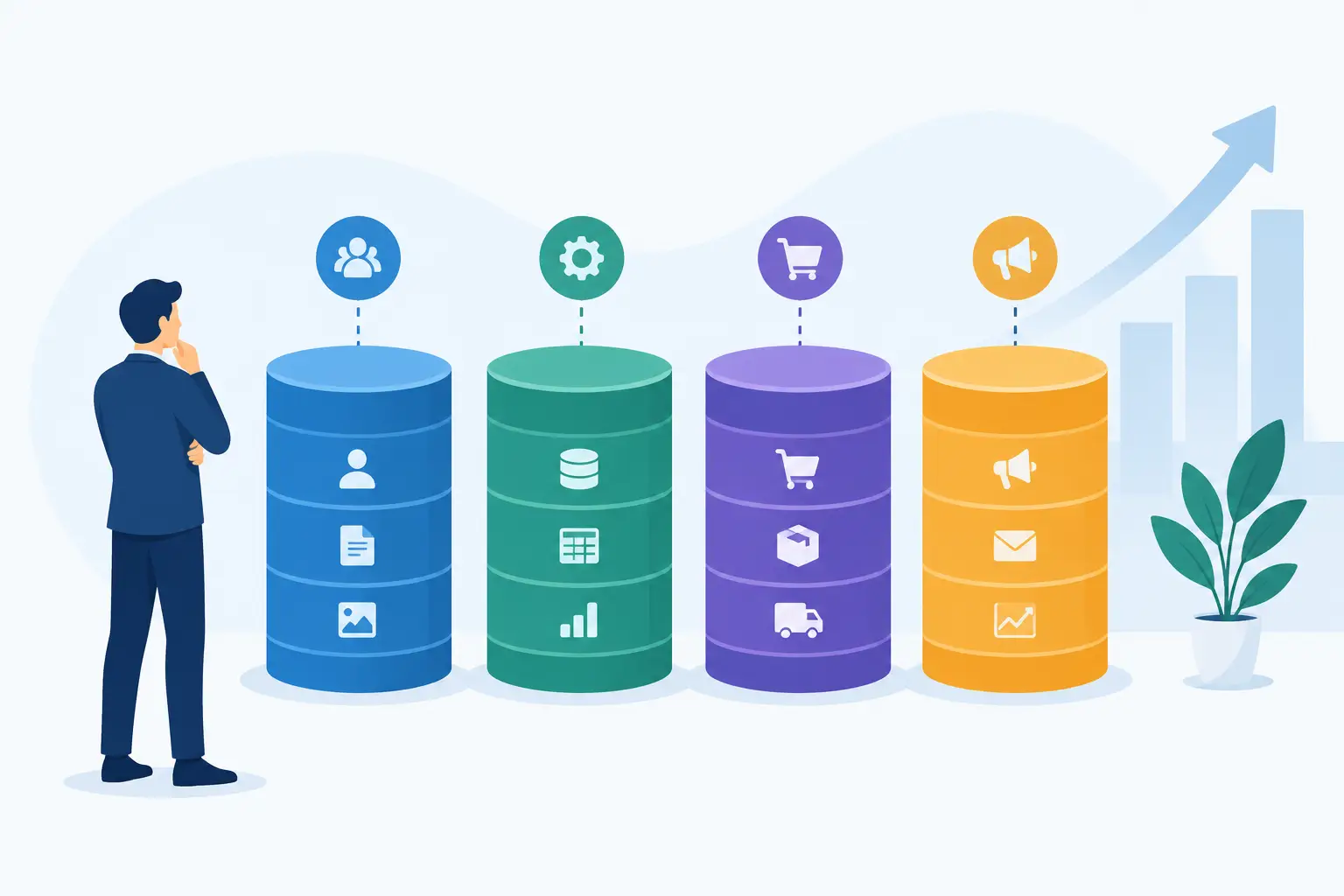
A sales manager changes a customer’s delivery details in the CRM. The warehouse still works from the ERP. Finance has a separate record in its accounting platform. By the time the order is dispatched, three teams may be working from three different versions of the truth. That is the everyday operational answer to what causes data silos: systems and processes change faster than the connections between them.
Data silos are not simply an IT problem. They create customer delays, duplicate work, reporting disputes and avoidable cost. For growing Australian businesses, they often appear gradually - one useful software purchase, spreadsheet or workaround at a time - until staff spend more effort reconciling information than acting on it.
What causes data silos?
A data silo exists when information is held in one system, team or process but is difficult for the people and systems that need it to access, trust or use. The data might technically be available somewhere. If it cannot move reliably into the workflow where a decision is made, it is effectively siloed.
The causes are usually commercial and operational before they are technical. A team buys a platform to solve an immediate problem. A department builds a report because the central system cannot answer a question quickly enough. An ecommerce platform is launched without a clean product-data connection to the ERP. Each decision can be reasonable on its own. Together, they create fragmented operations.
Software added without an integration plan
Most businesses run a mix of CRM, ERP, accounting, ecommerce, marketing, service and supplier systems. That is normal. The issue starts when each platform is selected and implemented as a standalone tool.
For example, an ecommerce team may need better merchandising features, while operations needs accurate stock, pricing and fulfilment data. If the ecommerce platform and ERP are not connected properly, staff resort to exports, imports and manual corrections. The business now has two copies of product information, two stock positions and more opportunities for errors.
A point-to-point connection can solve a short-term issue, but too many one-off integrations create their own maintenance burden. The right architecture depends on the number of systems, data volumes, timing requirements and how frequently the business changes. There is no prize for using the most complex integration technology. There is value in choosing a maintainable approach that keeps critical data moving.
Departments own processes, not shared data
Sales, finance, customer service and operations often measure success differently. Sales wants speed and clean pipeline visibility. Finance needs controlled records and accurate invoicing. Operations needs dependable order and inventory information. When each function manages its own process without agreed data ownership, the same customer, product or order can be represented differently across the business.
This is not usually caused by people being protective or uncooperative. Teams build local workarounds because they need to get work done. A spreadsheet maintained by one experienced employee may be the only reliable way to coordinate an exception. The risk is that a local solution becomes a hidden core system, with no clear controls, audit trail or continuity plan.
Shared definitions matter. Decide what counts as an active customer, which system owns the product master, when an order becomes confirmed, and who can change pricing. These are operating decisions, not merely database fields.
Manual workarounds become permanent
Spreadsheets are useful tools. They become a problem when they are the bridge between business-critical systems.
Copying leads from a website into a CRM, uploading supplier catalogue files, rekeying orders into an ERP and emailing approval details all create small gaps in the data flow. Each step introduces delays and judgement calls. Without a shared audit trail, it can also be difficult to see when information changed, who changed it or whether it was complete.
Manual processes can be appropriate for low-volume, unusual or high-risk work. A human review may be essential when approving a credit limit or resolving a complex customer issue. The goal is not to automate every click. It is to remove repetitive hand-offs where the rule is clear, while retaining oversight where judgement matters.
Poor data quality reduces trust
A silo can form even when systems are connected. If customer records contain duplicates, product codes vary between platforms, or addresses are incomplete, teams stop trusting shared data. They then keep private lists or rebuild reports outside the main systems. The silo returns, only now it is driven by confidence rather than access.
Data quality problems often originate at the point of entry. A free-text field where a validated selection is needed, inconsistent supplier files, or a rushed migration can create persistent cleanup work. Integration moves data, but it should also validate, transform and flag exceptions before poor records spread further.
A practical data model does not need to be perfect before work begins. It does need clear identifiers, ownership and rules for the records that matter most. Start with the data that drives revenue, delivery, compliance or customer experience.
Growth, acquisitions and changing platforms
Growth exposes weak connections. A business that could manage stock with a weekly CSV export may struggle once it adds multiple warehouses, marketplaces, supplier feeds or a larger customer base. For example, a process that works for ten orders a day may become difficult to manage at 500; those figures illustrate a change in workload, not a fixed threshold for replacing a system.
Acquisitions create another common source of silos. The acquired business may bring its own CRM, accounting processes, product catalogue and customer naming conventions. Forcing an immediate replacement of every platform can be expensive and disruptive. Leaving everything disconnected can also carry ongoing costs. In many cases, a staged integration approach gives the business shared visibility first, then supports a more deliberate system rationalisation plan.
The operational cost of disconnected data
The visible cost is often staff time. People spend hours checking stock, correcting addresses, reconciling reports and answering internal questions that a connected system should answer automatically. Another cost is slower decision-making.
When leaders cannot trust a sales report, margin view or customer history, they delay decisions or make them based on incomplete information. Customers notice the effects through inconsistent pricing, repeated questions and missed delivery expectations. Staff notice it through frustration and rework.
Silos also make automation less useful. AI can summarise enquiries, classify documents or draft responses, but it needs access to the right context and clearly defined permissions. Applying AI to fragmented, unreliable data can produce faster versions of the same confusion. Connect the source systems and establish review points first.
How to remove silos without replacing everything
Replacing every system is rarely the sensible first move. Established platforms may still perform well in their intended role. The more practical question is where the hand-offs fail and which data should move automatically between systems.
Start by mapping one or two high-value workflows from beginning to end. An order-to-cash process, supplier catalogue update or customer onboarding journey usually reveals the real gaps quickly. Identify each system involved, the data created or changed at every step, the current manual actions and the business owner responsible.
Then set a source of truth for each critical record. Your ERP may own stock and fulfilment status, while the CRM owns sales activity and the ecommerce platform presents approved catalogue data to customers. A source of truth does not mean no other system can display the data. It means there is a clear place where changes originate and rules for how those changes are shared.
Build integrations around the outcome, not the vendor feature list. A nightly sync may be enough for a low-risk supplier catalogue. Inventory availability for a busy online store may require near real-time updates. Some exceptions should create a task for a person rather than being pushed automatically. Good automation makes those decisions explicit.
Finally, monitor the flow. Integrations need clear error handling, alerts and ownership. If a supplier file fails to load or an order cannot be created, the business should know promptly and have a defined path to resolve it. Silent failures are simply data silos waiting to happen again.
The best first step is usually modest: choose a workflow where staff are repeatedly copying, checking or chasing information, then fix the underlying data movement. A well-designed connection there can remove daily friction, prove the value of a broader plan and give your business a cleaner base for the next stage of growth.
Codex builds custom software and systems integrations around existing business tools. Bring one recurring hand-off, the systems it touches and an example of the conflicting records to your first discussion. That gives the team a concrete starting point for agreeing ownership, validation and exception handling.