
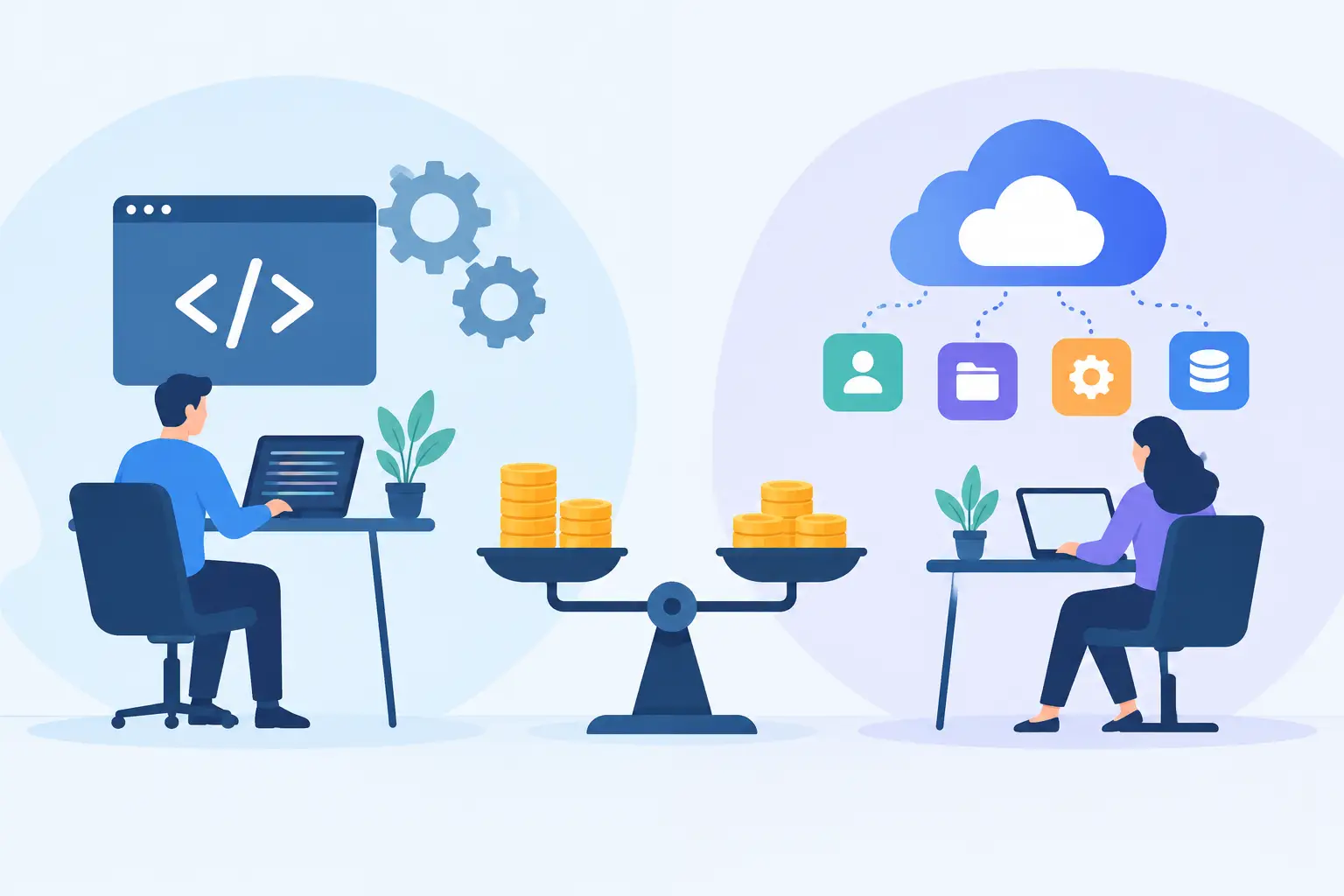
Imagine comparing an A$400-per-month SaaS tool with an A$60,000 custom build. These are hypothetical figures to explain the comparison, not Codex prices or market benchmarks. But custom software versus SaaS costs are rarely decided by the first invoice. The real comparison sits in the work that happens around the software: manual rekeying, duplicate records, integration add-ons, user licences, workarounds and the time spent adapting your operation to a platform built for somebody else.
For Australian businesses running a CRM, ecommerce store, ERP, supplier feeds and internal processes, the question is not whether SaaS or custom software is universally cheaper. It is which option produces the lower total cost while helping the business operate properly as it grows.
Start with total cost, not subscription price
SaaS spreads licence spending across recurring payments, although usage charges and price changes can affect predictability. That has genuine value. Teams can usually get started quickly, updates are handled by the vendor, and the initial financial commitment is lower than a tailored build.
The catch is that the monthly fee is only one line in the cost base. A SaaS product may charge separately for additional users, advanced reporting, API access, automation, storage, audit logs or higher transaction volumes. A business that starts with a basic plan can find itself on an enterprise tier within a year or two, often while still relying on spreadsheets to cover gaps.
Custom software has the opposite cost profile. The investment arrives upfront, with ongoing hosting, maintenance and enhancement costs after launch. It needs a clear business case and disciplined scope. Yet when the system removes a costly process or replaces several overlapping tools, its lifetime cost can become more favourable than recurring subscriptions.
A useful comparison accounts for at least three to five years, not just the next quarter. Include implementation, licences, integrations, staff time, training, support, data migration, security requirements and the commercial cost of processes that remain manual.
Where SaaS costs tend to rise
SaaS is often the right choice for standard business functions. Payroll, accounting, video meetings and basic customer support are good examples. These functions are broadly similar across organisations, and mature platforms can provide more capability than most businesses would sensibly build themselves.
Costs become harder to control when a platform sits at the centre of a unique workflow. Consider a parts distributor that needs supplier catalogue updates, stock availability, customer-specific pricing, ecommerce orders and ERP data to stay aligned. If each requirement calls for an add-on, middleware product, consultant or manual export, the subscription is no longer the whole solution.
There is also a common false economy in buying several low-cost tools to solve separate problems. Each may be affordable on its own. Together, they create disconnected data, multiple sources of truth and a growing reliance on staff to check that one system reflects another. The business pays in licences and in avoidable operational effort.
Vendor pricing changes matter too. A provider may alter tiers, restrict API access or package an essential feature into a more expensive plan. This does not make SaaS a poor model. It does mean a critical workflow should not depend on an assumption that today’s plan and pricing will remain suitable indefinitely.
Custom software versus SaaS costs at scale
The key difference between custom software versus SaaS costs is often the cost curve. SaaS expenditure usually rises with users, transactions, features or data volume. Custom software costs more at the beginning, then may scale more efficiently once the architecture is in place.
That does not mean every growing business should commission a bespoke platform. A custom build that copies a standard SaaS tool without delivering a material process advantage is difficult to justify. The strongest cases occur where the software can remove repeated labour, connect systems that cannot otherwise share reliable data, or create a customer experience that supports revenue.
For a worked example, suppose six staff each spend 10 hours a week reconciling orders, stock and customer information across 48 working weeks. That is 2,880 staff-hours a year: 6 × 10 × 48. This is an illustrative workload, not a customer result or a claim that all of those hours can be eliminated. Even before considering errors, delayed fulfilment or poor reporting, that is a meaningful operating cost. If an integration and tailored workflow reduce that work to review and exception handling, the return can be measured.
The same logic applies to customer portals and internal tools. When a portal gives customers accurate order information or enables self-service requests, it may reduce inbound administration while improving service. When an internal workflow guides staff through approvals and exceptions, it can shorten turnaround times and make reporting more dependable.
Calculate the cost of the current process
Before comparing quotes, map the process that the proposed software will change. Focus on the points where people move data, chase approvals, correct errors or wait for an update from another system.
Put a dollar value on staff time, but do not stop there. Estimate the effect on order turnaround, missed revenue, customer service, inventory accuracy and management reporting. If the problem only causes occasional inconvenience, a subscription product or a minor process adjustment may be enough. If it affects every order, customer or transaction, the case for purpose-built automation becomes much stronger.
Integration is usually the deciding cost
Many software decisions appear to be a choice between buying and building. In practice, the better approach is often to keep proven SaaS platforms and build the integration layer or workflow around them.
Your CRM may already be right for sales. Your ERP may remain the financial source of truth. Your ecommerce platform may be doing its job well. The issue is often that these systems were never designed to exchange the exact data your operation needs, at the timing your team needs it.
A tailored integration can synchronise products, orders, contacts, prices or status updates without replacing every system in the stack. This reduces platform disruption and directs custom development to the part that creates value. Productised connectors can be a practical alternative where the integration need is common and the scope is clear, while bespoke integration is appropriate for more specialised business rules.
Integration must still be designed properly. Cheap point-to-point connections can become brittle when a platform changes its API or an exception occurs. Good architecture defines the source of truth, handles failed transactions, records what happened and gives staff a sensible way to resolve exceptions. That work is an investment, not optional technical theatre.
Control, risk and ongoing ownership
Cost also includes what happens when your business changes. With SaaS, the vendor controls the product roadmap. You may request a feature, but you cannot rely on it arriving on your timetable. With custom software, you can control development priorities within your contract and technical constraints. Confirm source-code rights, third-party licences, handover access and support responsibilities before signing.
A well-built custom solution should not leave the business trapped with a single developer or obscure technology. Ownership of source code, clear documentation, maintainable cloud infrastructure and a planned support arrangement all matter. The aim is not to build everything from scratch. It is to own the logic that differentiates your operation and use established services where they make commercial sense.
AI automation follows the same rule. It can reduce the time spent summarising documents, routing requests or preparing drafts, but it requires defined oversight, clear data boundaries and a process for handling exceptions. Adding AI because it is fashionable creates another cost centre. Applying it to a high-volume, repeatable task can create a measurable return.
A practical decision framework
Choose SaaS when the process is standard, the product meets most requirements without costly workarounds, and pricing remains sensible at your expected scale. It is also a strong option when speed matters more than differentiation or when the business is still testing a new process.
Consider custom software or tailored integration when the workflow is central to how you win, serve or fulfil; staff repeatedly compensate for disconnected systems; or SaaS fees and add-ons are approaching the cost of owning a fit-for-purpose solution. The best answer can be a hybrid: retain the platforms that work, connect them cleanly and build only the capability that gives the business control.
A sound decision starts with one practical question: what would change in the business if this process worked without manual intervention? Put a number against that answer, then assess the technology options against it. That is how software spend becomes an operating decision rather than another subscription to manage.
Codex offers custom software and systems integration services. Bring current licence costs, a sample workflow and an estimate of manual handling time so the discussion can compare a contained integration with a broader build.