
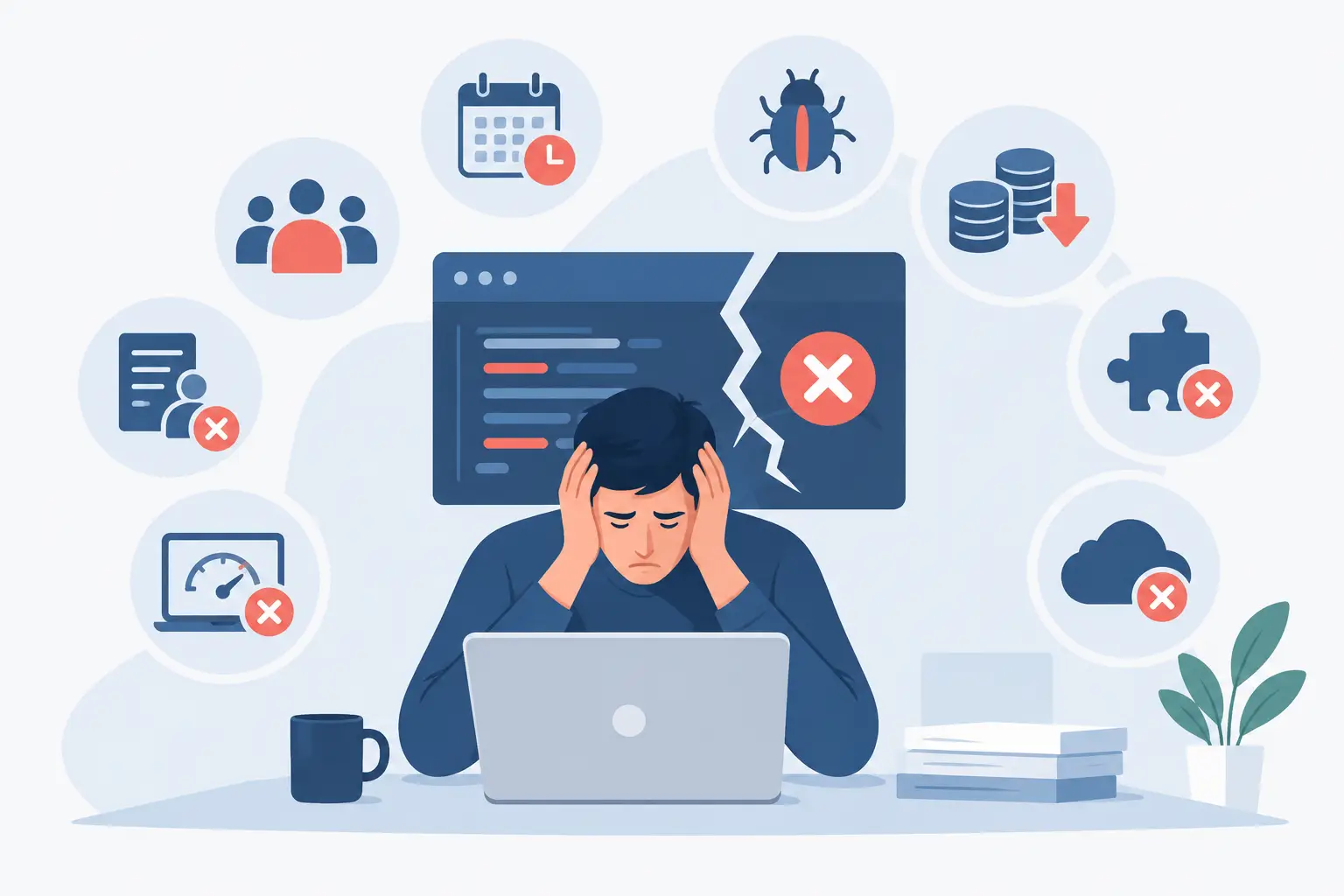
A new system can look finished, pass its technical checks and still fail the people expected to use it. Orders are still rekeyed, spreadsheets remain the source of truth, customer information is duplicated and the team develops another workaround. The question is not simply why do software projects fail at launch. It is why they fail to improve the business after launch.
For Australian businesses with a CRM, ERP, ecommerce store, supplier feeds and internal tools, software delivery is usually an operational change project disguised as a technology project. Code matters, but it is rarely the sole reason a project underperforms. This guide focuses on preventable risks: unclear commercial goals, disconnected decisions, poor data foundations and a delivery approach that leaves real users out until late in the project.
Why do software projects fail? Usually, the problem starts before development
Many projects begin with a proposed solution rather than a clearly defined problem. A business asks for a customer portal, a workflow platform or an AI assistant because the idea sounds useful. Yet the team has not agreed on which bottleneck it will remove, who owns the process, what information must move between systems or how success will be measured.
That creates a costly ambiguity. Different stakeholders assume the software will solve different problems, and each request can sound reasonable in isolation. Development continues, scope expands and the result becomes a collection of features rather than a system designed around a high-value workflow.
Before committing to a build, define the operational event that needs to improve. It could be reducing time from ecommerce order to fulfilment, eliminating manual catalogue updates, routing service requests correctly or giving customers accurate account information. A clear outcome makes design decisions easier and gives the project a basis for trade-offs.
1. The project solves the wrong problem
A visible pain point is not always the root cause. If staff spend hours correcting orders, the answer may not be another order-entry screen. The real issue could be inconsistent product data, missing API connections, unclear approval rules or a supplier feed that is not mapped correctly.
Building around the symptom creates software that adds another layer to an already fragmented process. This is especially common when businesses adopt off-the-shelf tools to fill individual gaps over several years. Each platform may work well on its own, but the hand-offs between them become manual, fragile and difficult to audit.
Good discovery follows the work from start to finish. It identifies where data originates, where it changes, who makes decisions and where exceptions occur. The aim is not to digitise every existing step. It is to remove unnecessary steps and make the remaining process easier to control.
2. Requirements are treated as a one-off document
Requirements need discipline, but they are not fixed forever. Businesses learn more once they see a process model, an early prototype or a working integration. The mistake is either locking every detail too early or allowing every new request into the build without assessing its cost and impact.
Both extremes damage delivery. A rigid specification can preserve assumptions that were wrong from the beginning. Uncontrolled change makes timelines and budgets unreliable, and it distracts the team from the outcome that justified the project.
A practical approach separates essential requirements from desirable improvements. The first release should handle the core workflow safely and visibly. Enhancements can follow once the business has evidence about what users need, not just opinions about what might be useful.
3. Integrations and data are left until late
The interface is often the most visible part of a software project. The harder work is usually behind it: matching customer records, synchronising product catalogues, handling stock updates, reconciling orders and deciding which system owns each field of data.
If these questions are deferred, the project can appear to progress quickly before slowing down near launch. Teams then discover duplicate customer IDs, incomplete product attributes, inconsistent naming conventions or an API that cannot support the assumed workflow. A polished portal is of limited value if it displays stale account information or sends incomplete orders into the ERP.
Integration design should start early. Map the source of truth for each critical data set, the direction and frequency of movement, the rules for conflicts and the response when a connection fails. Not every process needs real-time synchronisation. Scheduled updates may be cheaper and entirely suitable for some information, while pricing, availability or order status may require a faster response. The right choice depends on operational risk, not technical fashion.
4. There is no accountable business owner
Technology teams can build the system, but they cannot make unresolved business decisions on behalf of the organisation. When ownership is spread across a steering group, critical choices can sit unanswered: Who approves changes to the workflow? Who decides which data is authoritative? Who can prioritise competing requests?
A project needs a business owner with enough authority to make decisions and enough proximity to the process to understand the consequences. That person does not need to be technical. They do need to protect the intended outcome, involve the right people and make timely calls when trade-offs arise.
Without that ownership, software becomes a negotiation between departments. The build may satisfy everyone partly and nobody properly.
5. Delivery is organised around features, not value
Long projects with one major launch carry unnecessary risk. Requirements drift, business conditions change and users have little chance to validate whether the system works in practice. By the time concerns surface, the cost of changing direction is high.
Phased delivery creates earlier evidence. For example, a business might first connect a supplier catalogue to its ecommerce platform, then automate order flow, then add customer self-service functions. Each stage should solve a useful problem, not merely complete a technical component.
This does not mean every project must be broken into tiny releases. Some architecture and security decisions need to be made upfront, particularly where sensitive customer data, financial transactions or high transaction volumes are involved. The point is to balance sound foundations with regular validation, rather than treating a launch date as the first time the business sees the finished system.
6. Users are asked to adapt to poor process design
Software adoption is not a training problem alone. If a new system creates more clicks, removes useful context or forces staff to work around exceptions, people will return to email, spreadsheets and informal messages. They are often responding rationally to a tool that does not support the reality of their work.
Include the people who handle the process every day. They can identify the unusual cases that never appear in a management-level process map: split shipments, urgent customer requests, credit holds, partial supplier data and approval exceptions. These details should not automatically dictate the design, but they must be understood before the team decides how to handle them.
Training should focus on the new operating process, not only the software screens. Staff need to know what has changed, why it has changed and where responsibility sits when something does not go to plan.
7. Scope grows because decisions are not made
Scope creep is often blamed on demanding stakeholders. It can also be a symptom of weak prioritisation. When a project has no agreed definition of value, every request feels urgent and every exception becomes a reason to add another feature.
Change is sometimes necessary. A regulatory requirement, a major customer need or a newly discovered integration constraint may justify it. The discipline is to make the impact visible. For each proposed change, assess the benefit, delivery cost, effect on architecture and whether it displaces a more valuable item.
This keeps the project commercial. It also prevents a custom solution from becoming an expensive attempt to replicate every feature of a large subscription platform, including features the business will never use.
8. Success is measured by go-live, not business performance
Go-live is a milestone, not proof of success. A system can be available while the team continues to do manual reconciliation, customers avoid the portal or data quality worsens unnoticed.
Set a small number of measures before development begins. Depending on the workflow, these may include manual handling time, order error rates, time to respond to customer requests, catalogue update delays, support volume or the percentage of transactions processed without intervention. Establish a baseline where possible, then review performance after release.
These measures create a feedback loop. They show whether the system is producing the intended return and where a second phase will have the greatest effect.
How to reduce software project risk before the build begins
The strongest projects start with a short, focused planning phase that connects business operations to technical decisions. Document the current workflow, including exceptions. Identify the systems involved and the data each one owns. Agree on the outcome, the first release, the decision-maker and the measures that will indicate success.
From there, design for change without building for every hypothetical future need. Use clear integration boundaries, maintainable data models and practical monitoring so problems can be found before they interrupt operations. Where AI automation is part of the solution, define what it can draft, classify or route, and where a person must review or approve its output.
For businesses with multiple platforms, the best software project is rarely the one with the most features. It is the one that removes friction from a valuable process, keeps data moving accurately and gives the business more control as it grows. Build around that standard, and the project has a far better chance of earning its place in the operation.
For a custom software discussion with Codex, bring one workflow, its accountable owner and a baseline measure. Those inputs help turn a feature request into a delivery scope with a testable operational outcome.