
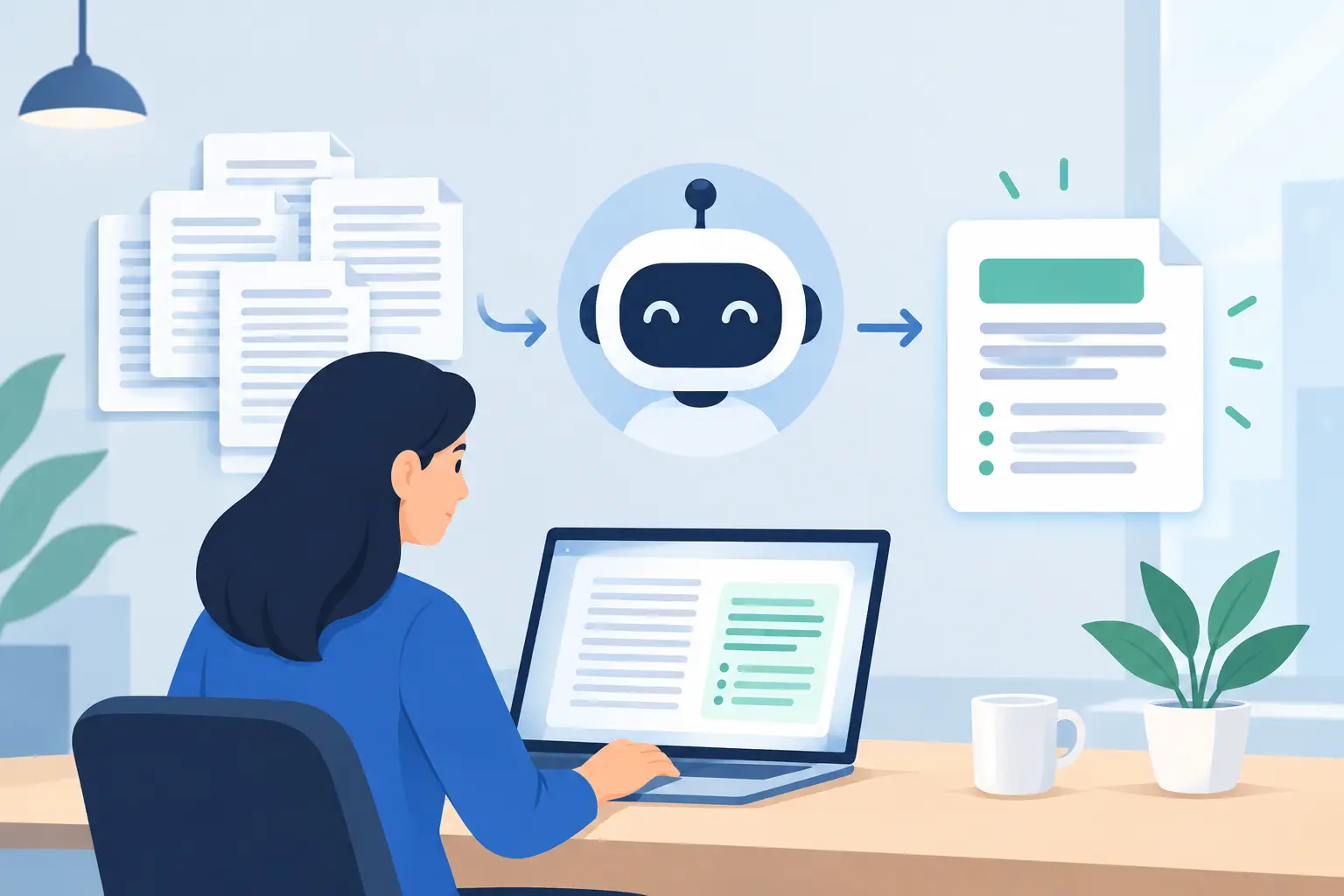
Imagine a contracts manager receiving 30 supplier agreements after a tender closes. An operations lead has incident reports, shift notes and customer emails to review before Monday. A sales team needs the key points from a lengthy proposal before a client meeting. The issue is rarely a lack of documents. It is the time required to find what matters, confirm what it means and act before the opportunity passes.
AI document summarisation for business can reduce that load. Used properly, it turns long, unstructured material into useful briefs, flags exceptions and moves the right information into the systems where work actually happens. Used carelessly, it creates confident-looking summaries that miss a liability, a deadline or a commercial commitment. The difference is in the design of the workflow, not simply the AI model selected.
Where AI document summarisation delivers value
The strongest use cases are repetitive, high-volume and time-sensitive. Teams should be reading documents because their judgement is needed, not because they are spending hours locating a renewal date buried on page 18.
For legal and commercial teams, an AI workflow can extract key terms from supplier contracts, including term length, renewal conditions, pricing changes, termination clauses and obligations. It can present those points in a consistent format, helping reviewers compare agreements quickly. The final interpretation should remain with the appropriate commercial or legal owner, particularly where wording is ambiguous or exposure is material.
In customer service, long email threads, case notes and attachments can be condensed into a clear history before a matter reaches an escalation team. Rather than asking a customer to repeat their story, staff can see the issue, actions taken, promised follow-up and outstanding question. That improves response quality as well as handling time.
Operations teams can use summarisation for maintenance reports, safety observations, handover notes, site updates and supplier correspondence. A daily digest may identify recurring faults, overdue actions or risks requiring attention. The practical benefit is not a shorter document. It is faster prioritisation.
Sales and account management teams can also summarise meeting notes, tender documents and client communications into CRM-ready records. The system can identify decision-makers, requirements, next steps and objections, then create a draft record for review. This reduces administrative drag without treating customer data as an afterthought.
AI document summarisation for business needs context
A generic request to summarise a document produces a generic result. Businesses get better results when they define what the summary is for, who will use it and what decisions it needs to support.
A finance manager reviewing an invoice dispute needs different information from a warehouse manager reviewing a delivery exception. One may need values, payment dates, disputed line items and agreed actions. The other may need affected stock, delivery references, customer impact and the immediate owner of the next task.
That is why a useful system uses a defined output structure. Instead of asking for a short summary, it can produce a purpose-built brief with fields such as document type, key dates, parties involved, decisions, risks, actions and confidence flags. The format should match the existing workflow, whether that is an ERP, CRM, service desk, internal portal or approval queue.
This also makes summaries easier to audit. A reviewer can see what the system extracted, compare it with the source document and correct it where required. Over time, those corrections reveal whether the workflow needs better instructions, a different document classification step or tighter rules around what can be automated.
Start with the process, not the model
The fastest way to waste money on AI is to apply it to a broken process with no clear owner. Before building anything, map the path a document takes from arrival to action. Identify where staff read, copy, re-key, chase or interpret information. Then identify the point at which a summary would genuinely remove work or improve a decision.
A practical implementation usually begins with one document family and one measurable outcome. For example, a business might start by summarising incoming supplier agreements to identify renewal dates and commercial changes. Another might focus on customer complaint emails, aiming to reduce the time required to prepare an escalation brief.
Set a baseline before switching the workflow on. Measure average review time, rework, missed follow-ups, processing volume and error rates. If the initiative cannot show an operational improvement, it is difficult to justify expanding it.
The system also needs a clear route for documents that do not fit. Poor scans, handwritten notes, incomplete attachments and unfamiliar templates should be flagged for manual handling rather than forced through an automated path. Exception handling is not a failure of automation. It is how reliable automation stays reliable.
Build human oversight into the right points
Not every summary requires the same level of review. A low-risk internal update may be safe to distribute automatically. A contract variation, safety incident or regulated customer communication should be reviewed before anyone relies on it.
The right control depends on consequence, not just document type. Consider whether an error could create financial loss, a compliance issue, reputational damage or an unsafe outcome. High-consequence workflows should preserve the source document, show the extracted evidence where practical and require an accountable person to approve the result.
It is also worth separating extraction from judgement. AI can identify a clause that refers to automatic renewal. Deciding whether that clause is commercially acceptable is a human decision. AI can group themes in staff feedback. Deciding how to respond is management work.
This boundary keeps responsibility clear and prevents teams from treating generated text as verified fact. It also builds trust. Staff are more likely to use a system when they can see how it reached an output and know where their expertise remains essential.
Connect summaries to the systems that run the business
A summary sitting in a shared inbox is only marginally better than the original document. The real value appears when information moves to the place where teams plan, sell, support, approve and report.
An incoming PDF can be classified, summarised and routed to the relevant queue. Key details can be written into a CRM record, an ERP workflow, a service ticket or a custom internal system. A renewal date can create a task before the notice period begins. A customer issue can trigger a priority rule. A delivery exception can be matched to an order and assigned to the right team.
Integration also reduces duplicate data entry, which is often where errors enter the process. Rather than asking staff to copy a summary across several platforms, a well-designed workflow creates a single controlled movement of data with an audit trail.
For Australian businesses handling commercial, employee or customer information, data governance needs to be part of the architecture from the outset. Clarify where documents are stored, who can access them, how long data is retained and whether the selected AI service is appropriate for the information being processed. Do not assume every document belongs in the same workflow or should be sent to the same provider.
Choose quality measures that matter
Summary quality is not just about whether the writing sounds polished. A concise, well-written answer that misses a critical deadline is not useful.
Test the system against a representative set of real documents. Review whether it captures the required facts, preserves important qualifications, identifies uncertainty and routes work correctly. Measure this alongside processing time and staff effort. Where documents contain tables, scans or complex layouts, test those conditions specifically. Results can vary significantly.
A sensible rollout is staged. Begin with a controlled pilot, review outputs with the people who currently do the work and refine the instructions and integrations. Once performance is dependable, expand by document type, team or workflow. This approach avoids a large, expensive program built on assumptions.
Custom workflow design matters here. A business with established systems does not need another isolated AI subscription that creates more copying and more logins. It needs automation that fits its existing data, approval steps and operational responsibilities. Codex approaches AI this way: as a practical layer within connected systems, built around a defined business outcome.
The best first project is usually not the biggest document problem. It is the one with enough volume to matter, clear rules for success and a person accountable for acting on the result. Get that workflow right, and document summarisation becomes less about producing shorter text and more about helping your business move with better information.